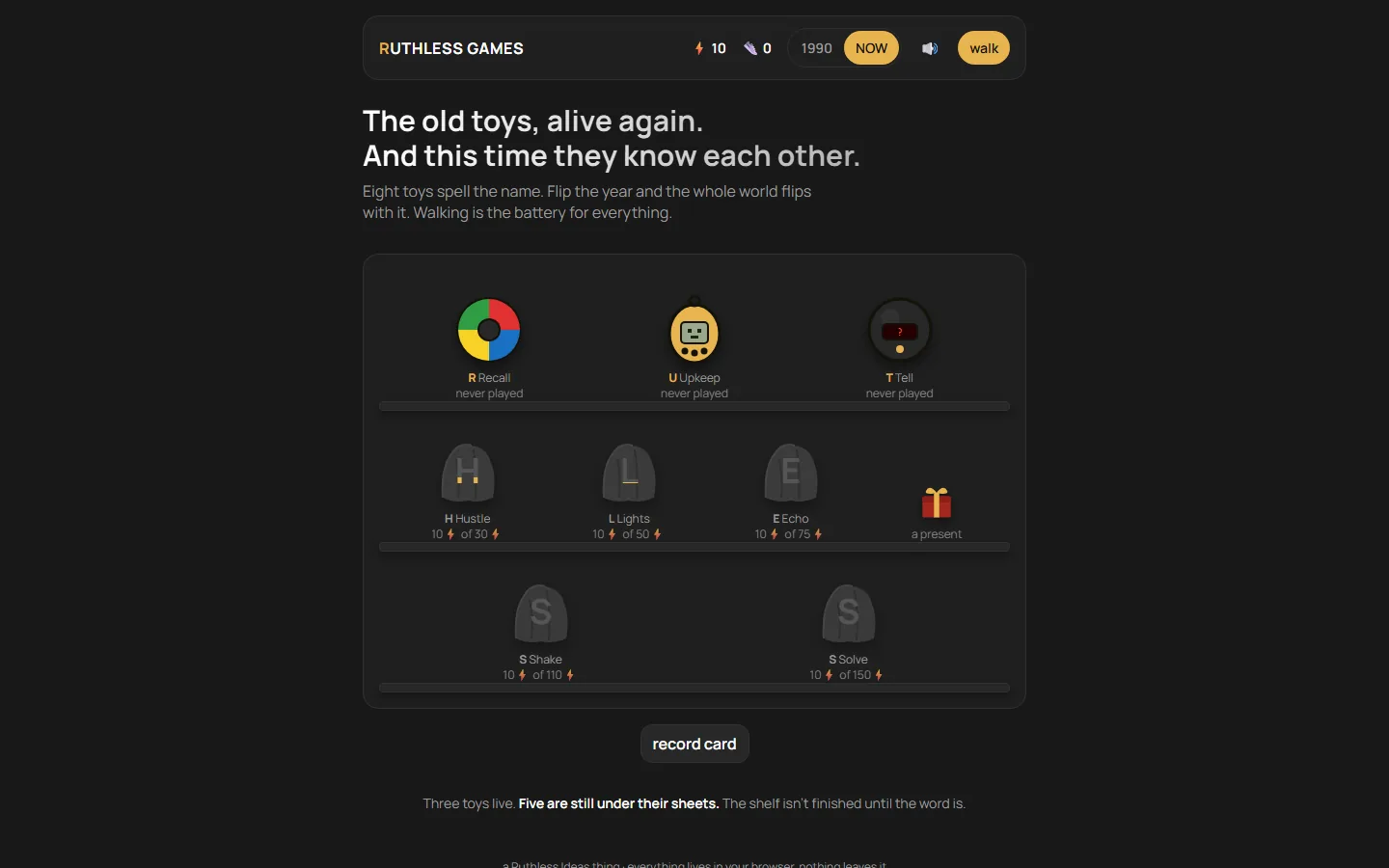
Ruthless Games
Eight handheld toys from the nineties, rebuilt in a browser and wired into one another.
The problem
The handheld toys of the nineties were each a sealed world. You fed one, you pressed the buttons on another, and nothing that happened on one ever reached the other. Every rebuild since has copied that isolation along with the graphics, so what you get is nostalgia in a box — one toy, played once.
The insight
Rebuild them together instead of separately. If the toys share a world, an action in one has consequences in the others, and the shelf becomes the product rather than any single toy on it. Walking is the battery: real steps power the whole shelf, so the thing that keeps it alive happens away from the screen.
How it works
- Eight toys sit on a shelf, and their first letters spell the name.
- Each is a working toy in its own right — one to keep alive, one to remember, one to guess with, and so on.
- They share one state, so what you do in one is felt in the others.
- Steps taken in the real world are the energy the shelf runs on.
- A switch flips the whole world between 1990 and now, and everything on the shelf changes with it.
Materials and process
Runs entirely in the browser. Nothing is sent anywhere and there is no account — the whole world lives on the device it is played on.
What exists now
Live and playable. Three of the eight toys are built; the other five are on the shelf under sheets. The site says so itself rather than hiding the gap, which is the right way round: the word is not finished until the shelf is.
Next: The remaining five toys.